Showing posts with label Scientist. Show all posts

Monday, September 29, 2014

Meet the Council: Two Newest Members of the Council

Dr. Crabtree swears in the two newest Council members
and Pam Dana renews her vows for her second term.


Members of the Gulf of Mexico Fishery Management Council are responsible for making important decisions for our fishery.  Luckily, the Council is populated with a variety of incredibly knowledgeable people with different perspectives about the resource. The two newest members of the Gulf Council are no exception.

Dr. Greg Stunz 
is a professor of Marine Biology at Texas A&M University in Corpus Christi, Texas. He also serves as the Director of the Center for Sportfish Science and Conservation and Endowed Chair for Fisheries and Ocean Health at the Harte Research Institute. 

Following his passion for fishing has taken him from the creek banks of the Texas Hill Country where he grew up, all the way to the depths of the Gulf of Mexico. It’s hard to imagine that as a small boy this man was squeamish to bait his own hook or fillet his own catch especially since these days he makes a habit of wrangling and satellite tagging large sharks.

When asked to describe his most interesting research Dr. Stunz doesn’t hesitate to describe the work he has been doing with sharks. “Satellite tagging sharks is really exciting for two reasons; first, catching and handling massive predators is thrilling and second, we know very little about sharks relative to other marine species so, it’s wonderful to uncover and share some very fundamental information about the animals and their migration.”

When asked about his favorite research Dr. Stunz points to his projects involving
catch and release mortality of some less dangerous finfish. “I started with spotted seatrout, currently working with red drum, and now continue on to look at red snapper. It’s incredibly interesting to look at the different factors contributing to fishing mortality and hopefully, we can find ways to reduce mortality after a fish is released.”

Although this is his first appointment to the Council, Dr. Stunz is no stranger to fisheries management. He has spent the past 20 years studying marine fisheries and has contributed scientific data for use in both state and federal fisheries management. He has served as a scientific advisor on the Council’s Scientific and Statistical Committee and he is on the Texas Parks & Wildlife Commission’s Coastal Resources Advisory Committee.

Dr. Stunz says he hopes to “use his scientific expertise to help promote sustainable fisheries in the Gulf.“ He also wants to “ensure access to the fishery to a diverse group of anglers and he looks forward to moving beyond red snapper issues to focus attention on some of the other species that are vitally important to the Gulf of Mexico.”


Captain David Walker, President of Walker Fishing Fleet, has been fishing professionally for 30 years. He started fishing recreationally with his father but, everything changed after his junior year of college when Walker got a summer job on a commercial longline boat and never returned to school. Instead, he opted to build his professional life as a commercial reef fish fisherman and boat captain.


When asked to describe his most memorable fishing trip David doesn’t hesitate to pick one out. “Things use to be different. We didn’t have the convenience of GPS, weather radars, and satellite phones that guide us now, so sometimes we found ourselves in some unpredictable situations. In 1988, I was fishing about 115 miles off-shore, southeast of The Flower Garden Banks and a bit north of the Bay of Campeche, Mexico. I caught the noon weather report on the single side band radio and found out that a storm had developed and was moving rapidly towards us at 21 knots. My boat didn’t run faster that 8 knots so, it was obvious that we weren’t going to be able to out run the storm. So, we did what any fishermen would, we continued to fish. Eventually, we decided to look for some good bottom where the anchor would hold so we could ride out the storm. By chance we happened upon a pipe laying boat and gained their permission to tie up behind them and ride out the storm. We hunkered down behind that boat for 8 hours in 16+ foot seas and 55 mph sustained winds - it was miserable.  However, mid-morning once the storm finally broke and the waves transformed into 12-14 foot soft rolling swells we decided to get back to work. After the worst night I’ve ever had on the boat we were rewarded with the best fishing I’ve ever seen. We fished three oil rigs and caught 5000 pounds of warsaw grouper before nightfall.”

Walker has incredible fishery experience both on and off the water. He got involved with the Gulf Council early in his career, regularly attending meetings and serving on a number of different advisory panels over the years. He has also been very involved with different fishing organizations including; The Gulf of Mexico Shareholders’ Alliance Board, The Gulf Coast Professional Fishermen, Share the Gulf, The Gulf Fisherman’s Association, Organized Seafood Association of Alabama, and Fish for America.

When asked what motivates him to serve as a member of the Gulf Council Walker says “I’ve spent my life connected to the commercial fishing industry and it’s important to make decisions that will keep fishermen fishing for years to come. We’ve come a long way in improving our fisheries and I want to find ways to make the Gulf a better place for all fishermen.”


David recognizes that “red snapper management isn’t working for everyone in the recreational sectors. We need to develop accountable and sustainable solutions that can benefit all people, whether they fish from their own boats, from charter boats, or they’re seafood consumers.”

Friday, November 15, 2013

Meet the Council: Dr. Bob Shipp - Reef Fish Committee Chairman from 2012 - 2013

The Gulf of Mexico Fishery Management Council is made up of people that have experience, expertise, and interest in the fishery. The chairman of the Council’s Reef Fish Committee is no exception. In fact, he is one of the most well known fisheries scientists across the Gulf coast.

Dr. Bob Shipp has spent his life researching and appreciating the fish of the Gulf of Mexico. His passion for the ocean was ignited at the early age of 4 by his grandfather with whom he enjoyed countless hours of surf fishing from the shores of Fort Walton Beach, Florida. As he grew a bit older he and his cousins spent summers snorkeling jetties and piers collecting fish and invertebrates for aquariums. Eventually, Bob got into SCUBA diving when it was first becoming a recreational activity.

During his childhood Dr. Shipp moved to New Orleans, Louisiana where he began his academic pursuit of fisheries. He focused on marine biology as much as he could, making it the topic of every school project possible. Dr. Shipp explains “My friends from those days joke with me now for being the only one of the group that followed through with my harebrained teenage career dreams.”

After graduating from Spring Hill College, Dr. Shipp attended Florida State University where he earned his master’s degree and PhD. Shortly thereafter he began working for the University of South Alabama teaching anatomy and physiology. He quickly moved into a fisheries biology position where his career flourished. He chaired the biology department and served as the acting director at the Sea Lab on Dauphin Island. He recently retired after serving 20 years as the chairman of the Department of Marine Sciences.

In addition to his work with the university, Dr. Shipp served for 12 years as the Director for the Alabama chapter of the Coastal Conservation Association. He has also been a judge for the Alabama Deep Sea Fishing Rodeo since 1982. He authors articles for multiple magazines and scientific papers, and he published “Dr. Bob Shipp’s Guide to Fishes of the Gulf of Mexico.”
Dr. Bob Shipp answered a few questions to give us some insight on his perspective of our Gulf fishery.

What is the most important issue in our fishery right now?
“I’m concerned that federal fishery law (the Magnuson-Stevens Act) prevents the Council from trying innovative fishery management techniques. Requiring species to be managed using quotas prevents the use of tools like Marine Protected Areas to manage our fish. Our hands are tied by the Act and it shows – the red snapper stock is healthier than it’s ever been, and we still have shorter and shorter fishing seasons – we obviously need the freedom to try something different.”

What can the Gulf Council do to improve management?
“The Council’s options are very few. Under the current system we can only tweak things rather than solve problems. The idea of Regional Management, for example, still only allows the Council to change some minor management measures like seasons and bag limits, while the major problems still remain.”

Where do you see fisheries management in the Gulf 10 years from now?
“There are two alternatives for our future; either Congress frees the hands of NOAA Fisheries so they have the freedom to manage properly, or the states will take more control. Either way, we can’t manage effectively if things remain as they are.”


Do you have a favorite fishing story to share?
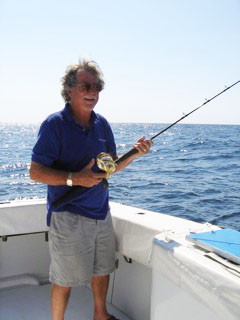
“I have a group of close friends that I went to high school with who wanted to experience some yellowfin tuna fishing. They are mostly freshwater fishermen and had not had the opportunity to spend much time off-shore. We all got together for a weekend after 41 years apart, and spent the day 100 miles out catching yellowfin. I had so much fun watching them experience such an amazing day on the water. We used kite baits, and at one point the tuna were leaping 8 feet out of the water. The excitement really transported us all back to our giddy 15-year-old selves again, and for that reason we now make the trip an annual event. It’s always one of my favorite outings of the year.”