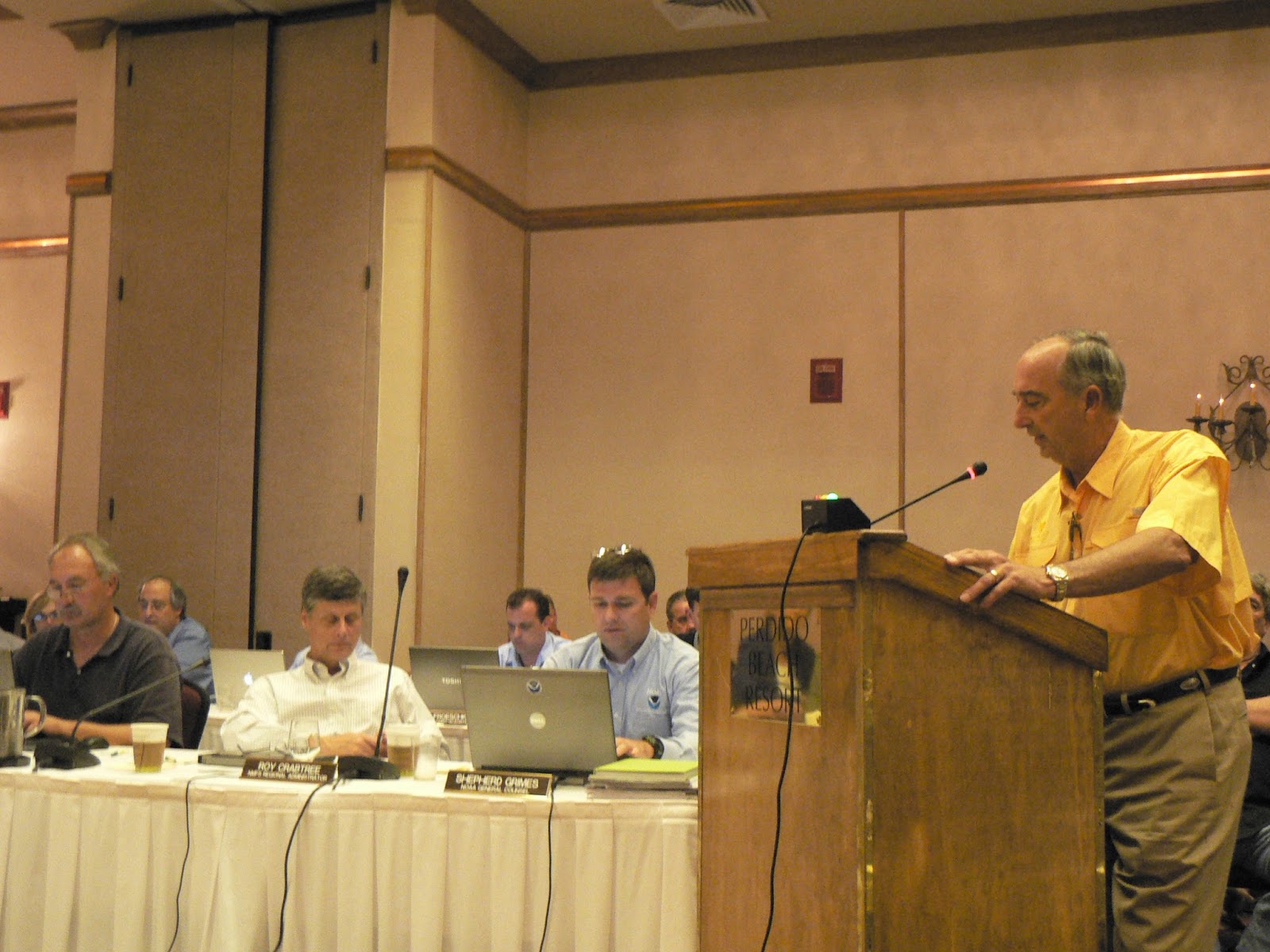
The Gulf of Mexico Fishery Management Council will meet in
Tampa, Florida on June 18th -21st. The meeting is open to
the public, so check out the
committee agenda and the
full Council agenda to
see what might interest you.
We also encourage you to take advantage of a couple of opportunities
for public participation during the Council meeting:
Question and Answer
Session- Tuesday, June 19th at about 5:30 pm, Dr. Roy Crabtree
(the Regional Administrator of NOAA Fisheries Southeast Regional Office) will
host and informal question and answer session. This is a great opportunity for
you to ask any questions you may have regarding fisheries management in the
Gulf.
Public Comment- Wednesday,
June 20th beginning at 2:00 pm, the Council will host a public
testimony session. We encourage you to come and share your fisheries management
related comments with the Council.
If you can't make it to the meeting in person we encourage you to watch it live on Gulf Council TV.
Below is a brief description of some of the issues the
Council will be working on. If you have any questions please contact me at:
Grouper
 |
| Photo: Troy Frady |
The 2013 recreational gag season - The Council will review
options that examine a split recreational season for gag. The Florida Fish and
Wildlife Commission (FWC) requested that the Gulf Council consider alternative
gag season options that would allow for fishing in both the spring and fall.
Opening the season at a different time may reduce the number of fishing days
but will allow for gag fishing at a more desirable time of year.
Check out the proposed changes in this
document and submit your comments to the Council about the 2013 gag season
here.
Changing the shallow-water grouper closed season - The
Council will review an options paper that explores the possibility of removing
or changing the current February - March shallow-water grouper closed season. This issue was initiated by fishermen
who reason that the closure is no longer necessary.
Read the document and submit your comments about the closure here.
Gag, red grouper, and black grouper allocation - The Council
will review an options paper that contains a range of possible permanent
allocations for gag, red grouper, and black grouper. Allocation is the division
of an Annual Catch Limit between commercial and recreational fishing sectors.
The current allocations are:
|
Commercial
|
Recreational
|
Gag
|
39%
|
61%
|
Red Grouper
|
76%
|
24%
|
Black Grouper
|
73%
|
27%
|
You can share your thoughts about the permanent allocation
of groupers with the Council by submitting public comment
here.
Shallow Water Grouper Accountability Measures - Currently,
if the gag or red grouper Annual Catch Limit is exceeded then the entire shallow-water
grouper season can be shortened the following year to ensure that the Annual
Catch Limit is not exceeded again. The Council will review a public hearing
draft of an amendment that may eliminate this accountability measure.
Read the
document and let the Council know what you think about the accountability measures
here.
Triggerfish
The 2012 recreational triggerfish season ends on June 11th.
The triggerfish stock is overfished (population is too low) and experiencing
overfishing (rate of removals is too high). The Annual Catch Limit was reduced
to prevent further overfishing and to allow the stock to rebuild to healthy
levels. Unfortunately, the recreational sector has caught its share of
triggerfish for the year, and the season must be closed.
The Council is working on an amendment that considers making
changes to triggerfish management so that the stock can rebuild while you
continue to fish. The Council will review an options paper that considers:
·
Shortening the current rebuilding plan
·
Increasing the commercial minimum size limit
·
Establishing a commercial closed season
·
Establishing a commercial trip limit
·
Increasing the recreational minimum size limit
·
Establishing a recreational closed season
·
Establishing a triggerfish–specific recreational
bag limit
·
Allowing NOAA Fisheries to close the fishery if
the Annual Catch Target is reached
Sector Separation
The Council will review a scoping document that begins to
formally analyze a possible separation of the recreational fishing sector into
sub-sectors. Currently, the Annual Catch Limit for most species is divided
between commercial and recreational fishing sectors. A sector allocation is the
amount of fish that can be harvested by a sector each year. The Council will
discuss the possibility of dividing the recreational sector allocation into
separate allocations for different types of recreation fishing (charter, headboat, private).
Share your thoughts with the Council
here.
Mackerels and
Cobia
 |
| Photo: Blaine Dedenbach |
The Council will continue working on two amendments for the
Costal Migratory Pelagic fishery.
Amendment 19 considers
limiting the sale of recreationally caught fish and making changes to the
permit requirements for Coastal Migratory Pelagic fisheries. Amendment 20
considers modifying commercial zone boundaries, changing the commercial opening
date for the western zone, establishing a transit provision, and requiring
vessel zone declarations.
Read what other people are saying about Amendment 19
here, and submit your own comments
here. Read what other folks are saying about Amendment 20
here, and submit your own thoughts
here.
For-Hire Fishing
Definition
The Council is working to clearly define the difference
between for-hire and private fishing trips in the Gulf. Specifically, the
Council will modify the definition of a charter vessel so that there is a definite
difference between vessels with for-hire permits that can take clients fishing
and private vessels that cannot collect fees or other compensation for engaging
in fishing activities in the federal waters of the Gulf.