Showing posts with label king. Show all posts

Thursday, March 31, 2016

April 2016 Council Meeting Preview

Photo: Joseph Cawthon
The Gulf of Mexico Fishery Management Council meets next week at the Doubletree Hotel in Austin, Texas to discuss some important decisions for our Gulf of Mexico fisheries. One of the hottest topics on the agenda is a presentation from National Marine Fisheries Service on this year's recreational red snapper season projection. 

You’re always welcome to join us in person but, since it’s not always practical to travel for a meeting, you can also watch a live broadcast of the meeting. This agenda and the background materials will help you be prepared for what the Council is addressing.

Public comment will be held on Wednesday, April 6th at 1:45 pm. If you can’t make it to the meeting to testify, visit this page on our website to submit comments and learn about all of the fisheries management issues we’re currently working on.

Here’s a quick look at some of the issues the Council will address next week: 

Modifications to Charter Vessel and Headboat Reporting 
The Council is working on an amendment that considers modifying the frequency and method of reporting for charter vessels and headboats fishing for reef fish and coastal migratory pelagics in the Gulf of Mexico. In January, the Council requested that the Southeast Fishery Science Center develop a flowchart illustrating alternatives for implementing electronic reporting for federally permitted for-hire vessels. During the April meeting, the Council will review the alternatives outlined in the flowchart and hear an update on the commercial electronic reporting pilot program. 

Photo: George Niles
King Mackerel
The Council is scheduled to take final action on Amendment 26 to the Coastal Migratory Pelagics fishery management plan. Amendment 26 considers changing allocations, stock boundaries, and sale provisions for king mackerel in the Gulf and South Atlantic. 

Red Snapper Management for Federally Permitted Charter Vessels
The Council will review the input received from the its Ad Hoc Red Snapper Charter-for-Hire Advisory Panel on Reef Fish Amendment 41 which considers creating a red snapper management plan for federally permitted for-hire vessels fishing under the for-hire component of the recreational red snapper allocation. The Council will also discuss the latest draft of the amendment and decide how to move forward.

Federal Reef Fish Headboat Management
The Council will also review a revised draft of Reef Fish Amendment 42 which considers creating a management plan for federally permitted headboats fishing for reef fish in the Gulf of Mexico. 

Photo: Ava Lasseter
Framework Action - Modify Red Grouper Annual Catch Limit
Based on its science advisors’ conclusions, the Council is considering whether to increase the ACL, which can be set below or equal to the acceptable biological catch (ABC).  The Council is scheduled to take final action on this Framework Amendment. 

Shrimp Amendment 17B
The Council will discuss Shrimp Amendment 17B which considers shrimp permit issues such as setting a minimum threshold number of Gulf shrimp vessel permits and whether to create a Gulf shrimp vessel permit reserve pool, specification of optimum yield, and issues about transiting in federal waters. The Council recently convened a working group to estimate the aggregate maximum sustainable yield and optimum yield for all shrimp species, and a summary report of that meeting will be provided to the Council.

Photo: Emily Muehlstein
Hogfish Annual Catch Limit, Minimum Size Limit, and Stock Definition
The Gulf Council is will review a public hearing draft of an Amendment that considers taking responsibility for the western stock of hogfish, which is located entirely in the Gulf of Mexico jurisdiction. The Council is also considering setting an annual catch limit and increasing both the commercial and recreational minimum size limit for hogfish. 
Click here to submit comments

As always, if you have any questions or concerns contact us at gulfcouncil@gulfcouncil.org

Monday, August 3, 2015

August 2015 Council Meeting Preview

Photo: Primofish
The Gulf of Mexico Fishery Management Council will meet next week at the Hilton Riverside in New Orleans, Louisiana.

You’re welcome to join us in person or watch a live broadcast of the meeting. This agenda will help you figure out when the Council will be discussing the fisheries issues that interest you and, here are all the documents you'll need to follow along. 

Public comment will be held from 1:00 pm  – 5:30 pm on Wednesday, August 12th. Below is a quick review of some of the issues the Council plans to address.


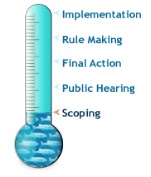
Hint: The Council reviews many different drafts of the same document before taking final action, and afterwards there are even more steps before a rule is implemented. This
thermometer shows how a document progresses through the Council process.


Photo: David Payne

Red Snapper

The Council plans to take final action on Amendment 28: Red Snapper Allocation – which considers reallocating a portion of the commercial red snapper quota to the recreational sector. We encourage you to watch this quick video and send us your comments so the Council can consider your input before making a final decision.

The Council will also finalize a framework action to withhold a portion of the commercial red snapper quota in 2016. This framework will ensure that the commercial allocation that the Council intends to shift to the recreational sector is available in 2016 even if the amendment isn’t implemented until after individual fishing quota is distributed among commercial fishermen.  

The Council will review revised alternatives in Amendment 39: Regional Management – which considers dividing the recreational red snapper quota among different regions in the Gulf to allow for the creation of different management measures that best suit each area.

The Council will also review a draft of Amendment 41 - which considers creating a management plan for federally permitted for-hire vessels fishing for red snapper. The options paper includes both charter vessels and headboats fishing under the for-hire component of the recreational red snapper allocation.

Data Collection
The Council will review a public hearing draft of an amendment being developed jointly between the Gulf and South Atlantic Councils, that considers modifying the frequency and method of reporting for charter and headboats fishing for reef fish and coastal migratory pelagics in the Gulf of Mexico, and snapper, grouper, dolphin, wahoo, and coastal migratory pelagics in the South Atlantic.

Reef Fish
Photo: G. French
The Council will look at a draft framework action that considers modifying the circle hook requirement for commercial yellowtail snapper fishing to address inconsistencies between Gulf of Mexico and South Atlantic Fishery Management Council regulations.

The Council will also review an options paper for Amendment 42 - which considers creating a management plan for federally permitted headboats fishing for reef fish in the Gulf of Mexico. The document considers which species to include, and how to manage the fishery.

Mackerel
At its June meeting, the Council reviewed input received during the scoping workshops for coastal migratory pelagic Amendments 26 and 28. Next week, the Council will review the options papers developed using the input from those workshops. Amendment 26 considers making modifications to allocations, stock boundaries and sale provisions of king mackerel, and Amendment 28 considers separating permits for Gulf and Atlantic king and Spanish mackerel.

Photo: Emily Muehlstein

Shrimp
The Council will review a draft options paper for Shrimp Amendment 17 – which considers what to do about the pending expiration of the federal shrimp permit moratorium.


Tuesday, June 2, 2015

June 2015 Council Meeting Preview

The Gulf of Mexico Fishery Management Council meets at the Marriot Beachside in Key West, Florida next week to discuss a number of fisheries issues.

You can watch a broadcast of the meeting live. Check out the committee and full Council agenda and briefing materials to figure out when the Council will be discussing the items that interest you. Public comment is scheduled from 3:30 – 5:30 p.m. Wednesday, June 10.

Photo: Tarpaw
On Thursday, the Gulf Council will meet jointly with the South Atlantic Fishery Management Council at the Doubletree Grand Key Resort inKey West, Florida to address fisheries issues that effect both Councils. Consult this agenda for the joint meeting schedule and briefing materials.

Here is a quick description of some of the things that will be addressed at next weeks meeting:

Mackerel
·      The Council plans to take final action of on the King Mackerel Gillnet Framework Action that considers changing the trip limit, accountability measures, reporting requirements, and inactive permits for the king mackerel gillnet fishery. Watch this quick video and send us your comments so Council can consider your input before making its final decision.

·      The Council will hear a summary of the input received during scoping on Amendment 26: Modifications to Allocations, Stock Boundaries, and Sale provisions of King Mackerel and Amendment 28: Separating Permits for Gulf and Atlantic Migratory Groups of King Mackerel.

Photo: Mary Othello Jackson
Red Snapper
·      The Council will review an updated draft of Amendment 28: Red Snapper Allocation – that considers reallocating a portion of the commercial red snapper quota to the recreational sector. The Council will also review a framework action to withhold a portion of the commercial red snapper quota in 2016. This framework will allow the allocation that the Council intends to shift to the recreational sector to be available in 2016 even if the amendment isn’t implemented until after individual fishing quota is distributed amongst commercial fishermen.  

·      The Council will review revised alternatives in Amendment39: Regional Management – that considers dividing the recreational red snapper quota among different regions in the Gulf to allow for the creation of different management measures that best suit each area.

·      The Council will take another look at the scoping document for Red Snapper IFQ Modifications before moving forward with an options paper.

Photo: Emily Muehlstein
Gag
The Council will review a framework action that considers adjusting the annual catch limits, annual catch targets, and recreational season for gag. Last year, a stock assessment concluded that the gag stock was no longer overfished or experiencing overfishing.

Shrimp
The Council will review an options paper for Amendment 17 that addresses the expiration of the shrimp permit moratorium and is expected to take final action on Shrimp Amendment 15. This amendment looks at adjusting the status determination criteria, such as the overfishing threshold, for brown, white, and pink  shrimp. It also considers changing the shrimp management plans’ framework procedure. If you’re interested in the proposed amendment watch the video, read the guide, and sendus your comments.

South Florida Management
The Gulf Council, South Atlantic Council, and State of Florida have been working on a fisheries management plan that aims to streamline regulations in South Florida, particularly off of the Florida Keys.  The Council will review an options paper that considers modifying the management structure and some management measures for yellowtail snapper, mutton snapper, black grouper and shallow-water grouper, to make fishing regulations less complicated for commercial and recreational fishermen in the area.

Photo: Emily Muehlstein
Hogfish

The Council will review the recommendations by its Scientific and Statistical Committee (SSC) relative to hogfish. The latest hogfish assessment determined that there are three distinct hogfish stocks. The western Florida stock is neither overfished or experiencing overfishing. The stock in the Florida Keys and along the east coast of Florida is overfished and experiencing overfishing, and the status of stock off the coast off Georgia and the Carolinas is experiencing overfishing and nearly overfished. The Council’s SSC reviewed the stock assessment and set an acceptable biological catch level for the west Florida stock. The SSC also recommended that the Gulf Council allow the South Atlantic Council to set the acceptable biological catch level for the Florida Keys stock.

Monday, December 29, 2014

2014 Year in Review: A Summary of Federal Fisheries Management in the Gulf of Mexico

We’ve been seeing red all year.
Among other things, red snapper, red grouper, red drum, and royal red shrimp have all been on the Council’s plate.
Here’s an overview of what we’ve done this year.

Photo: Mark Miller
Red Snapper
It’s been an especially active year for red snapper management and, despite some bumps along the way, we’ve begun to make some headway in solving the issues that anglers are faced with.

This year's recreational season was initially projected to be open for 40 days, but was cut to 9 days for two reasons: First, a court ruling determined that the Council and NMFS have not taken sufficient action to prevent the recreational sector from exceeding its quota. As a result, a 20% buffer was put on the recreational quota to avoid future overages. Second, new inconsistent state water seasons were announced and harvest in federal waters had to be reduced to account for landings that would occur in the newly formed state water seasons.

In an attempt to extend the recreational red snapper season the Council considered adding a slot limit to the recreational red snapper fishery. However, analysis suggests that release mortality of larger fish would be so high that adding a slot limit would have very little benefit.

To allow for more for-hire fishing opportunities the Council voted to remove a provision in Reef Fish Amendment 30B that requires federally permitted reef fish for-hire vessels to comply with the more restrictive federal regulations when fishing in state waters. That would have allowed the charter and headboats to fish during the state water seasons. However, after the court ruling, the Council decided to leave 30B in place because the already shortened federal red snapper season would have become even shorter if the for-hire boats fished in state waters during state seasons.

Photo: Captain Murphy
During the first half of the year, the Council worked on Reef Fish Amendment 28, which considers reallocating a portion of the commercial quota to the recreational sector. After holding public hearings the Council postponed action on the issue until the completion of Amendment 40 -Sector Separation. The Council also completed a framework action which proposes to establish buffers and payback provisions for overages in the red snapper fishery. The framework is currently under review by the Secretary of Commerce and red snapper Allocation will be revisited during the Council’s first meeting in 2015.

The Council hosted public hearings on Sector Separation and took final action in October. It voted to divide the recreational red snapper sector, creating separate private angling and for-hire components. This separation will allow the two components of the fishery to develop different management schemes tailored to each meet the needs of each group. Amendment 40 was transmitted to the Secretary of Commerce for review and approval before it is implemented.

Following final action on Sector Separation, the Council directed staff to prepare a framework action to consider reducing the red snapper bag limit of for-hire vessels in order to extend the season for the for-hire component of the fishery. The Council is expected to take final action on the proposal at its January meeting in 2015. 

The Council created an Ad Hoc For-hire Advisory Panel to advise on development of an amendment that would consider establishing a limited access privilege program for the fore-hire component of the red snapper fishery. The Council later changed the charge of the Advisory Panel and broadened it’s scope to consider all for-hire management options, not just IFQ based programs. That panel met in December and their recommendations will be reported to the Council in early 2015.

The Council resumed discussions on Red Snapper Regional Management - Amendment 39 after postponing work on the amendment until progress was made on the allocation of quota among regions. The Amendment considers dividing the recreational red snapper quota among different regions in the Gulf to allow for the creation of different management measures that best suit each area. The Council plans to continue work on regional management in 2015.

And finally, the Council has been working on a document that considers making modifications to the commercial red snapper IFQ program. Scoping meetings will be held in the spring of 2015.

Photo: Ryan Rindone
Red Grouper
Red grouper were also on the Councils plate this year. The 2014 recreational annual catch limit was exceeded triggering a bag limit reduction from four fish to three fish. Further, recreational red grouper fishing was closed October 4, when the annual catch limit was projected to be met.

After learning that the red grouper annual catch limit was exceeded the Council voted to make adjustments to promote year round recreational access in the future.  The Council reduced the recreational red grouper bag limit to two fish per person to help ensure recreational landings remain within the catch limit and accountability measures are not triggered. The framework action has been transmitted to the Secretary of Commerce and the red grouper bag limit will be 4 fish per person until the action is for approved and implemented some time this spring.

Photo: Tyler McLester
Red drum
This year, the Council considered allowing the recreational harvest of red drum out to nine nautical miles. Currently, there is a three nautical mile jurisdictional boundary off the states of Louisiana, Mississippi, and Alabama, while Texas and Florida have nine nautical mile limits.

The Council asked the states to provide more information on state water red drum fisheries to inform the stock assessment that is scheduled in 2016.  The Council is expected to reconsider the idea once more information is available.

Royal Red Shrimp
In March of this year the Council’s scientific advisors increased the royal red shrimp Acceptable Biological Catch. In response, the Council chose to increase the amount of royal reds that can be harvested to 337,000 pounds of tails. The Council also removed an accountability measures that allowed in-season closure the year following an overage to the annual catch limit.

And…. although they don’t have ‘red’ in their names mackerel and greater amberjack got some attention this year, too.

Photo: Mark Miller
Greater amberjack
This summer, the council scientific advisors reviewed a stock assessment and determined that greater amberjack did not meet the ten-year rebuilding plan that ended in 2012. The Council will consider adjusting the annual catch limit and commercial and recreational management measures to ensure that the stock rebuilds and the mandates of the Magnuson-Stevens Act are met.

Mackerel
In the spring, the Council chose to increase the Spanish mackerel annual catch limit through 2017.  Commercial king mackerel trip limits and fishing seasons were also adjusted.

Photo: Emily Muehlstein
In January of 2015 the Council plans to host a workshop at the request of the king mackerel gill net industry. At this workshop fishery managers and fishermen will discuss potential options to address industry concerns.

2014 has been a busy year in fisheries management for both recreational and commercial fisheries. Many of our fish stocks are improving and we’re working together to find management solutions that allow us to sustainably manage our Gulf fisheries while providing the best commercial and recreational fishing opportunities possible.