Showing posts with label reef. Show all posts

Thursday, September 10, 2015

Gulf Council Publishes Known Coral Locations in Gulf

Photo: sonarnavigator.net
As an offshore fisherman, you’ve probably spent a good bit of time on the water staring at your bottom machine in search of new fishing grounds. When the screen lights up with ripples or spikes you know the spot could be holding some awesome fish. And, if you’re anything like me, you wonder “what’s actually down there?”

As a diver, you might have the opportunity to see for yourself, or you can drop a camera overboard to get a better look. Chances are you’ll find some kind of reef. It might be artificial, it might be rocky, or it might be a coral reef. No matter what, you probably already associate reef structure with fish.

Photo: Sea Grant
Coral reefs are a crucial foundation for many of the marine species living in the Gulf of Mexico. They provide food, shelter, and nursery grounds to a seemingly endless list of fish, shellfish, marine mammals, and other inhabitants of all shapes and sizes. Many of the fish we target as commercial or recreational fishermen spend some part of their life on a reef feeding, growing, or seeking shelter – that’s why these habitats are so important.

Unfortunately, coral reefs, their health, and abundance, are threatened by many things including; oil spills, ocean acidification, climate change, and rising ocean temperatures.  Advances in technology such as satellite imagery and remote sensors that monitory the ever-changing ocean environment have allowed scientists to better understand the factors threatening coral reefs. Knowing the location of known coral communities allows for better management against the array of threats posed on corals.  

The coral web mapper created by the Gulf Council allows users to explore the different corals across the Gulf of Mexico. This database will allow scientists, managers, and the public, to interact with coral reef locations to make protecting them and understanding their risk much easier so potentially harmful factors can be managed before coral communities are endangered.

The five categories of corals/organisms that are depicted on the map tool are:
Photo: NOAA

  • Black Coral (or Antipatharians) – a group of branching corals are often associated with deep reef habits. Although their exterior flesh is usually red, white, or orange, their internal skeleton is black. Black corals can live to for thousands of years. In fact, one from the Gulf of Mexico was aged to be more than 2000 years old. These corals are a valuable tool for scientists because their skeletons contain rings, like trees. The rings have chemical signatures that allow scientists to learn about past oceanic environments. Black corals have also been harvested for jewelry, a practice which is not sustainable.
  • Hydrozoan Coral – colonies of individual animals that form a very rigid soft coral. Fire coral and lace coral are some of the best known colonies of hydrozoan. Hydrozoans have very interesting lives with two different life stages and two different strategies for reproduction. Hydrozoan coral colonies are made up of animals in the polyp stage of life when the animal is attached to a hard surface. Hydrozoan polyps reproduce by releasing buds that become free-swimming organisms. The free swimming hydrozoans are in the medusa state of life. They look very different from their stationary parents and reproduce sexually to form new polyps and begin the cycle again.
Photo: Sea Grant
  • Octocoral (or Anthozoans) – non reef-building soft corals. Octocorals can take on many different shapes, sizes, and colors but are easily identified in any form because they all have eight-fold symmetry. These corals are very hardy and can be some of the easiest corals to grow in aquariums.

  • Stony coral (or Scleractinians) –hard corals that are the primary reef building corals of the world. These corals have skeletons made of calcium carbonate (Aragonite), covered with polyps. All stony corals have a symbiotic relationship with algae that lives inside the polyps. The algae, called zooxanthellae, produce oxygen and other nutrients that are used by the polyps; the polyps produce carbon dioxide that is used by the algae. Brain corals and elkhorn corals are some of the more well known stony corals.
  • Sea Anemones –predatory animals are attached to the seafloor. They feed using tentacles that inject prey with paralyzing neurotoxins and then guide animals into their mouth for digestion. Like stony corals, some anemones have symbiotic relationships with algae that provide sugar and oxygen in exchange for shelter and exposure to the sun. Other anemones have mutualistic relationships with fish that live in their tentacles to escape predation from other fish.
Check out the map tool to explore this comprehensive inventory of known coral locations in the Gulf of Mexico.  Click on each spot for more information on the depth and coral type so you can get more familiar with the types of coral habitats that are common near your fishing grounds.

Friday, November 15, 2013

Meet the Council: Dr. Bob Shipp - Reef Fish Committee Chairman from 2012 - 2013

The Gulf of Mexico Fishery Management Council is made up of people that have experience, expertise, and interest in the fishery. The chairman of the Council’s Reef Fish Committee is no exception. In fact, he is one of the most well known fisheries scientists across the Gulf coast.

Dr. Bob Shipp has spent his life researching and appreciating the fish of the Gulf of Mexico. His passion for the ocean was ignited at the early age of 4 by his grandfather with whom he enjoyed countless hours of surf fishing from the shores of Fort Walton Beach, Florida. As he grew a bit older he and his cousins spent summers snorkeling jetties and piers collecting fish and invertebrates for aquariums. Eventually, Bob got into SCUBA diving when it was first becoming a recreational activity.

During his childhood Dr. Shipp moved to New Orleans, Louisiana where he began his academic pursuit of fisheries. He focused on marine biology as much as he could, making it the topic of every school project possible. Dr. Shipp explains “My friends from those days joke with me now for being the only one of the group that followed through with my harebrained teenage career dreams.”

After graduating from Spring Hill College, Dr. Shipp attended Florida State University where he earned his master’s degree and PhD. Shortly thereafter he began working for the University of South Alabama teaching anatomy and physiology. He quickly moved into a fisheries biology position where his career flourished. He chaired the biology department and served as the acting director at the Sea Lab on Dauphin Island. He recently retired after serving 20 years as the chairman of the Department of Marine Sciences.

In addition to his work with the university, Dr. Shipp served for 12 years as the Director for the Alabama chapter of the Coastal Conservation Association. He has also been a judge for the Alabama Deep Sea Fishing Rodeo since 1982. He authors articles for multiple magazines and scientific papers, and he published “Dr. Bob Shipp’s Guide to Fishes of the Gulf of Mexico.”
Dr. Bob Shipp answered a few questions to give us some insight on his perspective of our Gulf fishery.

What is the most important issue in our fishery right now?
“I’m concerned that federal fishery law (the Magnuson-Stevens Act) prevents the Council from trying innovative fishery management techniques. Requiring species to be managed using quotas prevents the use of tools like Marine Protected Areas to manage our fish. Our hands are tied by the Act and it shows – the red snapper stock is healthier than it’s ever been, and we still have shorter and shorter fishing seasons – we obviously need the freedom to try something different.”

What can the Gulf Council do to improve management?
“The Council’s options are very few. Under the current system we can only tweak things rather than solve problems. The idea of Regional Management, for example, still only allows the Council to change some minor management measures like seasons and bag limits, while the major problems still remain.”

Where do you see fisheries management in the Gulf 10 years from now?
“There are two alternatives for our future; either Congress frees the hands of NOAA Fisheries so they have the freedom to manage properly, or the states will take more control. Either way, we can’t manage effectively if things remain as they are.”


Do you have a favorite fishing story to share?
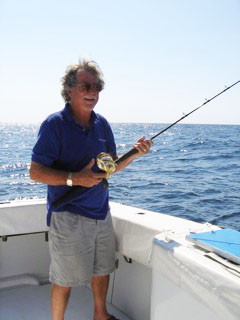
“I have a group of close friends that I went to high school with who wanted to experience some yellowfin tuna fishing. They are mostly freshwater fishermen and had not had the opportunity to spend much time off-shore. We all got together for a weekend after 41 years apart, and spent the day 100 miles out catching yellowfin. I had so much fun watching them experience such an amazing day on the water. We used kite baits, and at one point the tuna were leaping 8 feet out of the water. The excitement really transported us all back to our giddy 15-year-old selves again, and for that reason we now make the trip an annual event. It’s always one of my favorite outings of the year.”

Tuesday, June 5, 2012

Rig Removal - Essential Fish Habitat


Photo: Mike Miglini
Rig Removal - Essential Fish Habitat

Artificial reefs and their link to the Gulf fisheries has been a hot topic for the past few years. Scientists debate whether artificial reefs increase fish populations by expanding habitat opportunity or simply attract fish from other, less desirable habitat. It’s been difficult to determine which viewpoint is correct because artificial reef structures only account for about 1% of all hard bottom habitat in the Gulf. In either case, the Gulf of Mexico Fishery Management Council is concerned about the method and rate of oil and gas platform removal because the structures define the way people fish in some parts of the Gulf.

In recent years, the installation of new gas and oil structures has slowed. Additionally, the U.S. Department of Interior created the Idle Iron policy which requires all oil and gas structures to be removed no longer than a year after production is finished. Fishermen and conservation groups are concerned that the demolition and removal of rigs will harm our fisheries. Unfortunately, the Gulf Council has no authority to control the removal of rigs in the Gulf, which are under control of the Department of Interior. The Council has sent a series of letters asking the agencies responsible for rig removal to reconsider the use of explosives to remove rigs because explosives are known to kill fish dwelling near those structures. The Council has also asked that the rate of rig removal be  slowed or discontinued until more information is gathered regarding the effects of structure removal on the fishery.  The letters can be viewed here.

Photo: Mike Jennings
Many stakeholders have asked the Council to address the issue of rig removal by designating artificial structures Essential Fish Habitat. The map below shows the area (pink) of the Gulf that is currently considered Essential Fish Habitat. The red dots mark all known artificial reef structures in the gulf (approximately 5,127 acres). Although the artificial reefs themselves are not designated as Essential Fish Habitat, a vast majority of artificial structures (5,031 acres) fall within the area already designated as Essential Fish Habitat.  Currently, there are only 98 acres of artificial reef structure located outside the designated Essential Fish Habitat.

The Gulf of Mexico Fishery Management Council is developing a document that will  consider designating artificial reefs (structures intentionally placed as reefs and structures such as oil and gas platforms that are intended for other purposes but do provide fish habitat) as Essential Fish Habitat.  The designation of Essential Fish Habitat does not give the Council regulatory authority over those areas, but it does require other federal agencies (including the groups responsible for rig removal rates and methods) to consult with NOAA Fisheries on actions that will effect the Essential Fish Habitat.  The recommendations that NOAA fisheries makes to the agencies proposing action in Essential Fish Habitat are non-binding and serve an advisory role only.

While the designation of Essential Fish Habitat mandates the Council minimize the negative consequences fishing may have on the habitat. (Section 303(a)(7) of the Magnuson-Stevens Fishery Conservation and Management Act), it is not the Councils intent to limit fishing on artificial reefs if they are designated Essential Fish Habitat.

The Council plans to discuss an amendment that considers designating artificial reefs as Essential Fish Habitat at the next meeting, which is scheduled for June 18 – 21 in Tampa, FL.