Showing posts with label chairman. Show all posts

Friday, November 15, 2013

Meet the Council: Dr. Bob Shipp - Reef Fish Committee Chairman from 2012 - 2013

The Gulf of Mexico Fishery Management Council is made up of people that have experience, expertise, and interest in the fishery. The chairman of the Council’s Reef Fish Committee is no exception. In fact, he is one of the most well known fisheries scientists across the Gulf coast.

Dr. Bob Shipp has spent his life researching and appreciating the fish of the Gulf of Mexico. His passion for the ocean was ignited at the early age of 4 by his grandfather with whom he enjoyed countless hours of surf fishing from the shores of Fort Walton Beach, Florida. As he grew a bit older he and his cousins spent summers snorkeling jetties and piers collecting fish and invertebrates for aquariums. Eventually, Bob got into SCUBA diving when it was first becoming a recreational activity.

During his childhood Dr. Shipp moved to New Orleans, Louisiana where he began his academic pursuit of fisheries. He focused on marine biology as much as he could, making it the topic of every school project possible. Dr. Shipp explains “My friends from those days joke with me now for being the only one of the group that followed through with my harebrained teenage career dreams.”

After graduating from Spring Hill College, Dr. Shipp attended Florida State University where he earned his master’s degree and PhD. Shortly thereafter he began working for the University of South Alabama teaching anatomy and physiology. He quickly moved into a fisheries biology position where his career flourished. He chaired the biology department and served as the acting director at the Sea Lab on Dauphin Island. He recently retired after serving 20 years as the chairman of the Department of Marine Sciences.

In addition to his work with the university, Dr. Shipp served for 12 years as the Director for the Alabama chapter of the Coastal Conservation Association. He has also been a judge for the Alabama Deep Sea Fishing Rodeo since 1982. He authors articles for multiple magazines and scientific papers, and he published “Dr. Bob Shipp’s Guide to Fishes of the Gulf of Mexico.”
Dr. Bob Shipp answered a few questions to give us some insight on his perspective of our Gulf fishery.

What is the most important issue in our fishery right now?
“I’m concerned that federal fishery law (the Magnuson-Stevens Act) prevents the Council from trying innovative fishery management techniques. Requiring species to be managed using quotas prevents the use of tools like Marine Protected Areas to manage our fish. Our hands are tied by the Act and it shows – the red snapper stock is healthier than it’s ever been, and we still have shorter and shorter fishing seasons – we obviously need the freedom to try something different.”

What can the Gulf Council do to improve management?
“The Council’s options are very few. Under the current system we can only tweak things rather than solve problems. The idea of Regional Management, for example, still only allows the Council to change some minor management measures like seasons and bag limits, while the major problems still remain.”

Where do you see fisheries management in the Gulf 10 years from now?
“There are two alternatives for our future; either Congress frees the hands of NOAA Fisheries so they have the freedom to manage properly, or the states will take more control. Either way, we can’t manage effectively if things remain as they are.”


Do you have a favorite fishing story to share?
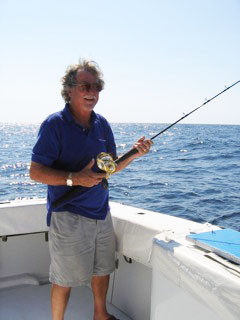
“I have a group of close friends that I went to high school with who wanted to experience some yellowfin tuna fishing. They are mostly freshwater fishermen and had not had the opportunity to spend much time off-shore. We all got together for a weekend after 41 years apart, and spent the day 100 miles out catching yellowfin. I had so much fun watching them experience such an amazing day on the water. We used kite baits, and at one point the tuna were leaping 8 feet out of the water. The excitement really transported us all back to our giddy 15-year-old selves again, and for that reason we now make the trip an annual event. It’s always one of my favorite outings of the year.”

Tuesday, March 26, 2013

Meet the Council: Chairman Kevin Anson


Gulf of Mexico Fishery Management Council
Do you ever wonder what qualifies members of the Gulf of Mexico Fishery Management Council to make decisions about our fish? After all, they play an important role in fisheries management, and decisions they make could potentially affect us all. 

Council members are tasked with a very difficult challenge; to balance competing interests in the fishery to make management recommendations that achieve the greatest overall benefit to the nation.

Each Council member is selected to serve because they have personal experience, expertise, and interest in the Gulf fisheries. Lets get to know another member of the Gulf Council so that we can better understand his perspective.

Kevin Anson, the Chairman of the Gulf Council, laughs when asked how he got into fisheries. “To this day my parents joke that my entertainment wasn’t a toy but an aquarium,” he said.

Beginning at about age 2, the fish tank in Kevin’s family home mesmerized him, and he could sit in front of it for hours without losing interest.

Kevin with a Nassau Grouper
Kevin’s passion for marine life grew along with him. During his childhood, Kevin’s family moved around the state of Florida where he was exposed to both salt and freshwater environments. His family spent every spare moment at a vacation home in the lower Florida Keys. Kevin would disappear each morning with a goal to bring home dinner. He spent his days diving for lobster, spearfishing, trolling for Dolphin and mackerel, and bottom fishing.

When it came time to choose a career, Kevin decided to attend Florida Atlantic University to pursue a degree in Ocean Engineering. Within a couple of years he realized engineering was not his passion, and he graduated with a Bachelor of Arts in Anthropology. Kevin then attended Auburn University where he earned a Master of Science in Fisheries and Allied Aquacultures.

Kevin in the Florida Keys
For a short time after graduation Kevin worked for the Alabama Cooperative Fish Research unit sampling fish populations living in rivers associated with hydroelectric dams. He moved on to work for a tropical fish hatchery in South Alabama. Kevin even worked for a few years at the company’s aquaculture facilities in Belize growing shrimp, Australian red claw crayfish, and tilapia.

Kevin is currently the Chief Marine Biologist for the Alabama Department of Conservation and Natural Resources/Marine Resources Division. He has been with the Department for 14 years, and has served as Alabama’s representative on the Gulf of Mexico Fishery Management Council since 2008.

His passion for fisheries extends beyond his professional life. He lives in coastal Alabama and fishes from his 23-foot walk-around boat. If you want to get in touch with Kevin you are welcome to email him directly at: Kevin.Anson@dcnr.alabama.gov

To conclude our get-to-know-you with Kevin, here are his answers to a few questions about fisheries management in the Gulf:

What do you think is the most important issue in our fishery?
“Improvement of fisheries science is a top priority on everyone’s mind, including mine. I want to make sure that more data about artificial reefs and the fish populations living on them are included into the stock assessments and considered by the Council’s Scientific and Statistical Committee to inform management decisions made by the Council.”

What can the Council do to improve the fisheries management around the Gulf?
“We must continue to enhance our relationships with stakeholders. We need to be sure that information is user-friendly and easy to access, and we need to take every opportunity we can to engage the public in the management process. Bringing the Council into the public arena will make it easier for us to collaborate with, and learn from, the folks who are affected by Council decisions.”

What do you believe is the ultimate goal of fisheries management?
“Fisheries management should maximize people’s enjoyment of our resource now, and in the future. Our fisheries should be protected so that we can enjoy them for future generations. At the same time, when populations are healthy and sustainable, we should strive to provide every opportunity to utilize them.”

Do you have a favorite fishing tale you can share with us?
“Some of my fondest fishing memories involve taking novices out for their first taste of saltwater fishing.

“I took a friend offshore for his first time to catch red snapper. We anchored over a nice artificial reef, baited our hooks, and dropped our lines off opposite sides of the boat. Almost immediately, my buddy hooked into a nice snapper and began to pull her to the surface, and I hooked up as he was mid-fight.

Kevin fighting a Tarpon
“My friend reeled his fish to the surface and decided to wait for me to finish my fight so I could help him boat his fish. As he was waiting, he noticed something dark swimming below the boat. I heard the tone of his voice shift, and he was on the brink of panic as he informed me that a shark was after his snapper.

“I quickly released my fish and went over to help him, only to discover that the “shark” causing my buddy so much distress was actually the biggest cobia I’ve ever seen in my life. After boating his sow and poking a bit of fun at him, I tried every trick I knew to coax that big cobia onto my hook. I never did manage to catch him, but really enjoyed the opportunity to see such a huge cobia.”

Tuesday, December 18, 2012

Meet the Council: Chairman Doug Boyd (Chair from 2012 -2014)


Gulf of Mexico Fishery Management Council
The Gulf of Mexico Fishery Management Council is responsible for making some pretty important decisions. So who is this group of people? And, what qualifies them to make fishery management decisions?

It’s about time we get to know the members of the Gulf Council a little better. After all, they’re responsible for balancing different perspectives, and sometimes competing interests, to make regulations that affect us all.

Each Council member is selected to serve because of their personal experience, expertise, and interest in the Gulf fisheries. Let’s pull back the curtain and introduce them to you so that you can better understand their perspectives, and perhaps find a connection with the folks who share your passion for the fishery.

We’ll start this series by introducing the Chairman of the Gulf Council, Doug Boyd. He’s a dynamic and hard working guy with numerous interests and hobbies, including fishing. Over the years, Doug has invested a significant amount of time and effort representing recreational anglers on different government advisory panels and advocacy groups. His expertise and familiarity serving on advisory boards helped launch him into the position of Chairman during his first term as a member of the Gulf Council.

Doug’s first passion in life was not found underwater; quite the opposite in fact. He was drawn to the airfields where he did manual labor in exchange for flying time. Doug eventually washed enough planes and changed enough oil to complete his lessons and become a commercial pilot. When the Vietnam War began, Doug took a civilian contract with the U.S. Air Force working as an instructor pilot teaching primary flight training to Vietnamese student pilots.

After completing his contract with the U.S. Air Force, Doug spent 30 years working as a banker in San Antonio, Texas. He has since retired and now owns a small construction company that builds custom residential properties. Doug has also found an excuse to pursue his passion for antiques by partnering with a home décor company to share a small storefront where he sells antiques from his collection.

Doug and fellow Council members reading their Oath
In addition to being a businessman, husband, and father, Doug found time to get involved with fisheries advocacy and management. He joined the Coastal Conservation Association (CCA), a recreational fishing advocacy group, in the early 1980’s. Doug has since become a board member for CCA Texas where he serves as the Vice President. and he sits on CCA’s national board. Doug is a longtime member of the U.S. Fish and Wildlife Services Sport Fishing and Boating Partnership Council responsible for conserving, restoring, and enhancing aquatic resources for recreational fishing and boating. Doug also sits on the Shrimp Advisory Panel for the Texas Parks and Wildlife Department.

Doug currently lives in the Texas hill country in a town called Boerne. He also owns a little fish camp down in Port O’Connor, Texas. If you want to get in touch with him you can connect with him directly at: douglassboyd@yahoo.com

Finally, to close our get-to-know-you with Doug, I asked him a few questions about fisheries management in the Gulf. Here’s what he had to say:

What motivates you to serve on the Gulf of Mexico Fishery Management Council?
“I want to try and preserve the critters and keep the fisheries a viable resource for us and for the people who come after us. The world is not ours, we are caretakers put here for a generation, and we don’t want to misuse the resource that has been given to us. Don’t get me wrong, I want to fish and I want to eat fish, I just want to be sure that is possible for everyone that comes after me, too.”

What do you think is the most important issue in our fishery?
“Right now, improving the accuracy and timeliness of our fisheries science is the most important thing for us to focus on. With improved data we can make better management decisions that allow us to be more accurate in utilizing the resource to its full potential without harming the future of the fishery.”

How do you hope to improve the fisheries science?
“I want to work collectively with the Council’s science advisors (the Scientific and Statistical Committee) and the NOAA Fisheries Southeast Science Center to make sure that the fisheries science we already have is useful and accurate. I want everyone to constantly double check that we’re doing things as accurately and thoroughly as possible. We need to keep working to improve the data, even if we get to the point where we think it’s good enough we need to always look forward and anticipate how we can do better.”

Do you have a favorite fishing tale you can share with us?
“Two of my most memorable fishing moments in the recent past involve unexpected encounters.

I was wade fishing a flat for redfish in Port Mansfield, Texas in crystal clear water. I was standing about waist deep and noticed towards the shore in the shallows there was a massive fish running after bait. This animal repeatedly chased bait to the shore where it would break the surface and little fish would explode out of the water. Of course it piqued my interest, and I wanted a chance to catch whatever was feeding, so I moved towards the action. The closer I got to the shore the further I got from the safety of my anchored boat. When I got within casing distance I realized that the feeding fish was actually a tiger shark, and a hungry one at that. It was a beautiful sight, but I didn’t stick around to watch what happened next.

A few months later, I had an opportunity to fish some unfamiliar waters at the mouth of Mobile Bay in Fort Morgan, Alabama. I went wading on the beach and made my way to the second sandbar in waist deep water. I had to practically swim through the deeper channels to get to my spot, but it paid off because fish were everywhere. I was playing around catching skipjacks one after another until I noticed a huge dark shadow slowly moving towards me and the school of fish I was catching. I took off as the shadow approached closer and closer and retreated back to the first sandbar. That’s when I realized that I was being stalked by nothing more that a curious manatee.”