
The first article in this series, “How Hard Can it Really be to Count Fish?” describes how scientists
use fisheries-dependent data collection to monitor fish populations by tracking
harvest and fishing effort. While fisheries-dependent information is important
for management and plays a role in stock assessments, it has its limitations.
To use an analogy: you can’t estimate the amount of water in a well by simply
looking in the bucket. Likewise, you can’t assess a fish stock by simply
looking at what is being caught - you have to study the fish directly.
Fisheries-independent data collection does just that. State,
federal, and university-based fisheries scientists directly sample fish
populations in a variety of ways to collect information about the life history
and abundance of each species.
Life history studies focus on the biology of a fish. The way
a species survives and reproduces plays a major role in its ability to sustain
a healthy population. Fisheries scientists use the following techniques to
study the life history of fishes in the Gulf of Mexico:
 |
| Photo: Amy Piko |
Otolith Analysis -
An otolith is a bone found in the fish’s ear. Much like counting the rings of a
tree trunk, the age of a fish can be determined by counting the rings on an
otolith. This information, paired with information about the length of a fish,
is used to determine the growth rates of fish and estimate the percent of fish
at each age in a stock.
 |
| Photo: Karen Burns |
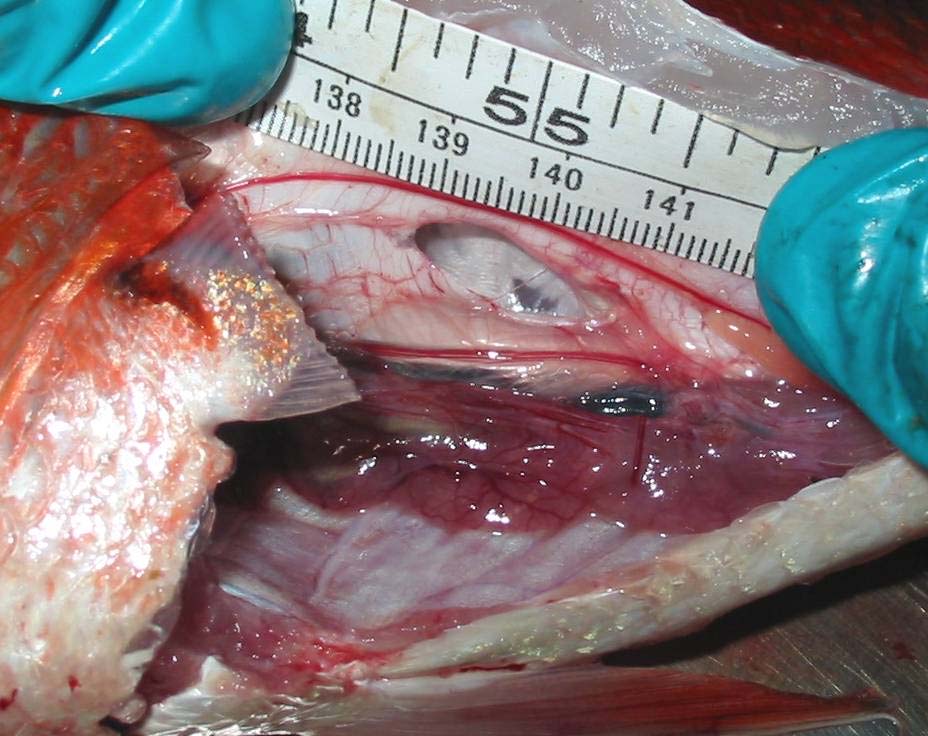
Gonad Analysis - Gonads, or the reproductive organs of a fish, can be analyzed to determine the potential for spawning success. Reproductive information collected from gonads includes the age at
which a fish first spawns, the male to female ratio within a population, and the number of eggs produced by a female each year.
 |
| Photo: Emily Muelstein |
Capture and Release -
A couple different techniques are used to study the death rates, growth rates,
To determine whether a fish survives release they are either
fitted with acoustic tags that monitor movement, or they are placed in
underwater cages and revisited after a few days time.
In addition to life history information, fisheries-independent
studies collect information on how many fish are in an area. The techniques
used to study abundance all measure the amount of fish caught per unit of
effort. When compared year after year, these studies can show trends in population
size and location.
 |
| Photo: NOAA |
Trawl Surveys - Researchers pull large nets behind a research vessel and observers are sometimes placed aboard shrimp vessels to monitor bycatch. These survey techniques are used mostly to estimate the amount of juvenile fish of a particular species that can potentially grow large enough for harvest (often red snapper).
 |
| Photo: FWRI |
Traps - Baited fish traps are placed in different types of habitat (artificial structures, natural reefs, and sand bottom, among others) to compare which species are present at each type of location.
 |
| Photo: NOAA |
Direct Observation- SCUBA Divers survey different areas and count fish.
 |
| Photo: FWRI |
Video Surveys -
Video cameras are placed in different habitats to record and measure the amount
of
fish in the area, and to gather information about fish size.
 |
| Photo: Emily Muelstein |
Hook and Line - Scientists also collect information about fish by fishing with standardized gear and sometimes using electric reels. This is an effective way to collect samples around structures that would interfere with nets and other types of sampling gear.
 |
| Photo: Kathy Hoak |
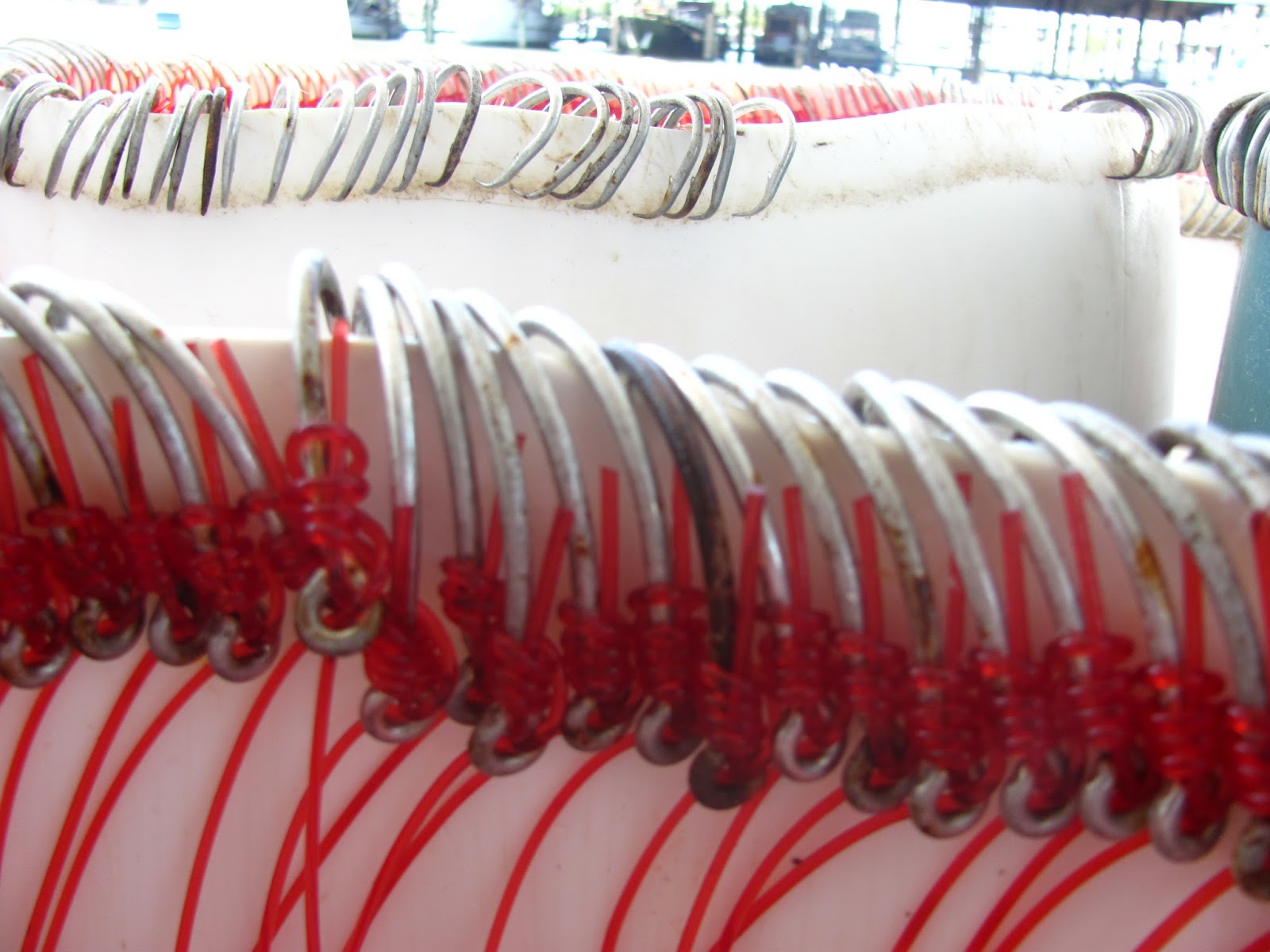
Longlines - A longline is a very long fishing line with multiple hooks branching off the main line.
 |
| Photo: NOAA |
Plankton Tows - Bongo nets are used to collect small organisms drifting in the water. Tiny fish found in the plankton samples can indicate the number of young born each year, and scientists can estimate their potential to grow into adults that can later be harvested.
Fisheries science is so complex because the subject it
studies is vast, difficult to access, and exists in an ever-changing
environment. The wide variety of fisheries-independent and fisheries-dependent
studies performed in the Gulf of Mexico provide us with snapshots of different
aspects of the fishery. The conclusions drawn from each individual study have
value on their own, but assessing a stock throughout the entire Gulf requires a
combination of all of these studies in order to formulate a comprehensive
understanding of what’s going on.
The final installment of “How Hard Can it Really be to Count Fish?”
will describe how scientists combine the conclusions drawn from
individual studies for use in a Stock Assessment, which gives fisheries
managers the information they need on a stock’s status so they can make
management decisions.


