Wednesday, June 12, 2013

June 2013 Council Meeting Preview


Photo: Emily Muelstein
The Gulf of Mexico Fishery Management Council will meet next week at the Crowne Plaza in Pensacola, Florida. The meeting is open to the public, but if you can’t make it you can listen in live from your computer.

The committee agenda and full Council agenda will help you figure out when the Council will be discussing the topics that you want to hear.

Public comment will be held Thursday, June 20th beginning at 1:00 pm. An informal question and answer session will be held Tuesday evening immediately after the Council adjourns (around 5:15).

The following is a brief description of some of the things the Council plans to address next week:

Red Snapper
·      Stock Assessment Results - A benchmark red snapper stock assessment was recently completed. The Council’s the Scientific and Statistical Committee (SSC) reviewed the assessment results and increased the acceptable biological catch for three years. The Council will review the assessment and, based on the SSC recommendations will set quotas for 2013 and beyond.

Photo: Capt. Murphy
·      Allocation - The Council will revisit the allocation scoping document that considers changing the division of the red snapper annual catch limit between the commercial and recreational fishing sectors. Currently, 49% of red snapper is allocated to the recreational sector and 51% to the commercial sector.

·      Regional Management – The Council will review a public hearing draft of Amendment 39, which considers dividing the federal red snapper quota among states/regions, giving them more flexibility in choosing seasons and bag limits. Regional management would not necessarily result in more fishing days.

·      Red Snapper Individual Fishing Quota (IFQ) Program - The Council will discuss Amendment 36, which will address potential modifications to the Red Snapper IFQ Program based on the 5-year review recently accepted by the Council.

Artificial Reef Habitat Protection
The Council will discuss an options paper that considers designating petroleum platforms and artificial reefs as Essential Fish Habitat. This article “Rig Removal – Essential Fish Habitat” explains some of the motivations and challenges associated with the actions being considered by the Council.
Photo: Mark Miller

Data Collection
·      Private Recreational Red Snapper Data – The Council will review a scoping document that considers different options, suggested by the Council's advisory panel for Private Recreational Data Collection, for improving private recreational red snapper fisheries data. 

·      Headboat Reporting Requirements-           
    The Council will take final action on a framework action that considers changing how frequently headboats are required to report their catch. 

Mackerels and Cobia
The Council will review recommendations from its advisory panel for Coastal Migratory Pelagics on Amendments 19 and 20. Amendment 19 addresses the recreational sale of king and Spanish mackerel, elimination of inactive commercial king mackerel permits, and income requirements for commercial fishing permits. Amendment 20 addresses trip limits, seasons, transit provisions, and annual catch limits and annual catch targets for cobia.

Photo: Capt. Murphy
Shrimp
The Council will review recommendations made by its Shrimp advisory panel shrimp and discuss a framework action that considers how to fund the Electronic Logbook Program.

Panel and Committee Selection
The Council will review resumes and select new members for the Coral and SEDAR NGO Advisory Panels, as well as the SEDAR workshop pool, Special Coral, and Special Mackerel Scientific and Statistical Committees.

If you can’t make it to the meeting, there are plenty of other ways to share your input with us. This quick video explains public involvement in fisheries management:


As always, if you have any questions please contact us.

Thursday, June 6, 2013

How Hard Can it Really be to Count Fish? - Fisheries Independent Data Collection

It’s simply impossible to accurately count each individual fish swimming in the Gulf of Mexico, but not for lack of desire. The size, depth, and diversity of the Gulf makes accounting for every single fish unmanageable using current technology.

The first article in this series, How Hard Can it Really be to Count Fish? describes how scientists use fisheries-dependent data collection to monitor fish populations by tracking harvest and fishing effort. While fisheries-dependent information is important for management and plays a role in stock assessments, it has its limitations. To use an analogy: you can’t estimate the amount of water in a well by simply looking in the bucket. Likewise, you can’t assess a fish stock by simply looking at what is being caught - you have to study the fish directly.

Fisheries-independent data collection does just that. State, federal, and university-based fisheries scientists directly sample fish populations in a variety of ways to collect information about the life history and abundance of each species.

Life history studies focus on the biology of a fish. The way a species survives and reproduces plays a major role in its ability to sustain a healthy population. Fisheries scientists use the following techniques to study the life history of fishes in the Gulf of Mexico:

Photo: Amy Piko


Otolith Analysis - An otolith is a bone found in the fish’s ear. Much like counting the rings of a tree trunk, the age of a fish can be determined by counting the rings on an otolith. This information, paired with information about the length of a fish, is used to determine the growth rates of fish and estimate the percent of fish at each age in a stock.


Photo: Karen Burns


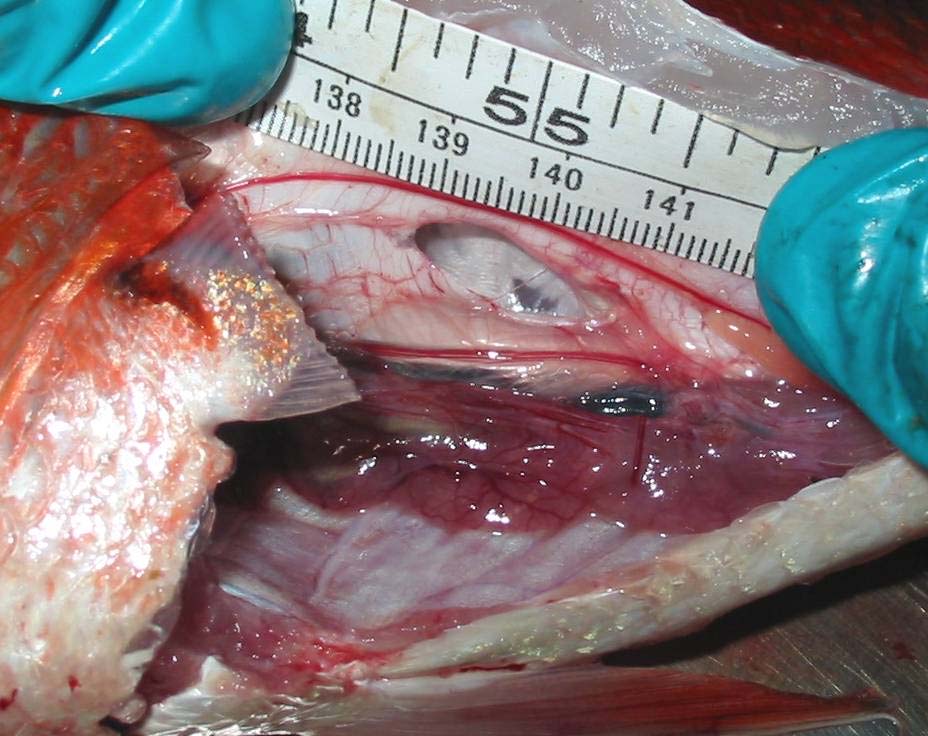
Gonad Analysis - Gonads, or the reproductive organs of a fish, can be analyzed to determine the potential for spawning success. Reproductive information collected from gonads includes the age at

which a fish first spawns, the male to female ratio within a population, and the number of eggs produced by a female each year.


Photo: Emily Muelstein
Capture and Release - A couple different techniques are used to study the death rates, growth rates,
and movement of fish. Scientists catch fish, tag them, and ask anglers who recapture them to report information about location and size of the fish.

To determine whether a fish survives release they are either fitted with acoustic tags that monitor movement, or they are placed in underwater cages and revisited after a few days time.

In addition to life history information, fisheries-independent studies collect information on how many fish are in an area. The techniques used to study abundance all measure the amount of fish caught per unit of effort. When compared year after year, these studies can show trends in population size and location.

Photo: NOAA

Trawl Surveys - Researchers pull large nets behind a research vessel and observers are sometimes placed aboard shrimp vessels to monitor bycatch. These survey techniques are used mostly to estimate the amount of juvenile fish of a particular species that can potentially grow large enough for harvest (often red snapper).


Photo: FWRI


Traps - Baited fish traps are placed in different types of habitat (artificial structures, natural reefs, and sand bottom, among others) to compare which species are present at each type of location.


Photo: NOAA


Direct Observation- SCUBA Divers survey different areas and count fish.


Photo: FWRI


Video Surveys - Video cameras are placed in different habitats to record and measure the amount of
fish in the area, and to gather information about fish size.


Photo: Emily Muelstein


Hook and Line - Scientists also collect information about fish by fishing with standardized gear and sometimes using electric reels. This is an effective way to collect samples around structures that would interfere with nets and other types of sampling gear.


Photo: Kathy Hoak

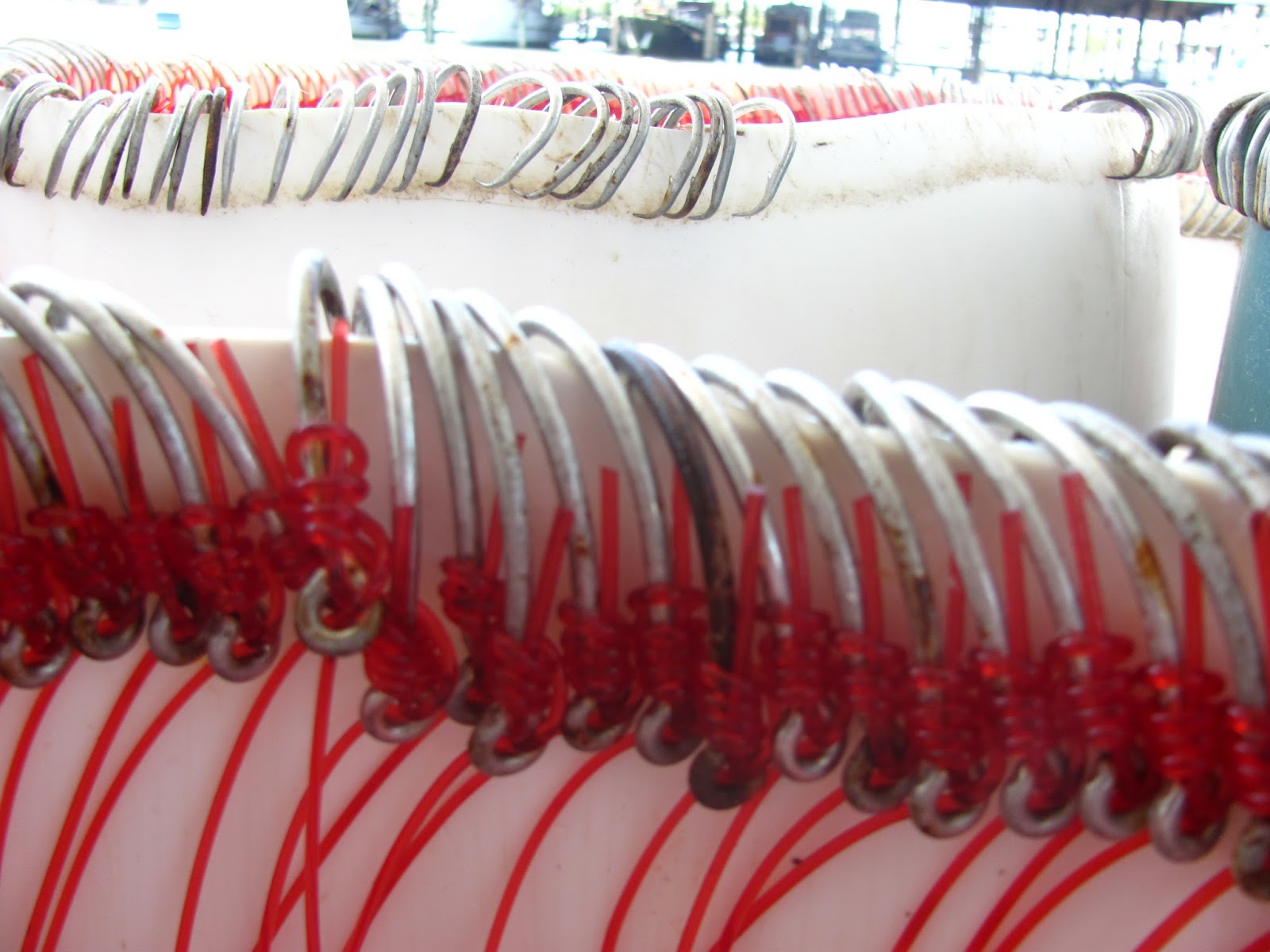
Longlines - A longline is a very long fishing line with multiple hooks branching off the main line.
Longlines can be miles long and rigged with hundreds of hooks at a time. Longlines that fish vertically can be used around structure, but lines fished at the surface or along the bottom are intentionally set to avoid it.


Photo: NOAA


Plankton Tows - Bongo nets are used to collect small organisms drifting in the water. Tiny fish found in the plankton samples can indicate the number of young born each year, and scientists can estimate their potential to grow into adults that can later be harvested.

Fisheries science is so complex because the subject it studies is vast, difficult to access, and exists in an ever-changing environment. The wide variety of fisheries-independent and fisheries-dependent studies performed in the Gulf of Mexico provide us with snapshots of different aspects of the fishery. The conclusions drawn from each individual study have value on their own, but assessing a stock throughout the entire Gulf requires a combination of all of these studies in order to formulate a comprehensive understanding of what’s going on.

The final installment of How Hard Can it Really be to Count Fish?”
will describe how scientists combine the conclusions drawn from individual studies for use in a Stock Assessment, which gives fisheries managers the information they need on a stock’s status so they can make management decisions. 

Thursday, May 16, 2013

How Hard Can it Really be to Count Fish? - Fisheries Dependent Data Collection


Photo: NOAA
It’s hard to count fish. Not only do they move, but they are hidden from plain sight within the depths of the ocean. To complicate things, an overwhelming number of variables like weather, tide, and habitat make straightforward data collection difficult and test the limitations of gear and technology.  

Fisheries science is just as complex and multifaceted as the subject it studies. Biology, ecology, oceanography, population dynamics, economics, and sociology are all woven together to create the discipline of fisheries science, which formulates our understanding of fisheries and informs fisheries management decisions.

Photo: LA Seafood
There are two very general categories of data that are used in tandem by fisheries scientists to assess fish stocks. The first is fisheries independent data in which scientists use a variety of different sampling techniques like netting, trapping, and direct observation to collect fisheries information. The second is fisheries dependent data, which relies on fishing activity and is collected with the help of professional and recreational fishermen.

Fisheries dependent data collected from commercial and recreational anglers plays an important role in determining the status of fish stocks. Harvest, especially as it relates to the amount of fishing effort, can help fisheries scientists identify trends in fish populations over time. Fisheries dependent data is also used to predict and monitor harvest during a fishing year. This is particularly important for species that are managed with a quota.  Fishing seasons are set based on past trends of fishing activity, and in-season monitoring of fishing activity prevents overfishing of a stock by tracking harvest so a sector can close when a quota is met.

Photo: NOAA
Commercial Data Collection
In the Gulf of Mexico, fisheries dependent data is fairly easily and accurately collected from commercial fishermen, in part because there are fewer than 900 commercial reef fish vessels Gulf-wide. Also, the commercial Individual Fishing Quota (IFQ) Program, a management tool used to constrain the commercial harvest of certain fish species, created requirements that have improved data collection among the commercial fishing sector. The following is a list and brief description of the fisheries dependent data collection techniques used in the commercial fishery that contribute to stock assessments. 

Onboard Observers - NOAA fisheries personnel ride along to observe fishing activities on about 1% of all commercial fishing trips. The vessels are randomly selected for participation and observations are conducted in all seasons, around the Gulf, aboard vessels using each type of fishing gear.

Logbooks - All commercial reef fish fishermen are required to document their effort and catch for each fishing trip.  A random 20% of all the commercial fishermen are also required to fill out logbooks detailing their dead discards. Ten percent of al logbooks are audited by NOAA Fisheries.

Vessel Monitoring - Commercial reef fish vessels participating in the IFQ program must be equipped with a tracking device (vessel monitoring system) that is active at all times. The vessels are also required to notify NOAA Fisheries before departing on a trip and 3 hours before the boat returns to shore.

Electronic Reporting and Trip Tickets - Commercial fishing vessels in the IFQ program must report their catch before the boat reaches shore.  Once the boat lands, the fish dealers purchasing fish harvested under the IFQ program must enter data about the price, amount, and species of fish purchased.

Dockside Monitoring - Interviews are conducted by dockside monitors who collect information on species, size, age, and fishing effort from commercial fishermen returning from fishing trips.

Photo: Emily Muehlstein
Recreational Data Collection
The recreational fishing sector includes both private fishermen and fisherman on for-hire trips. The for-hire component of the fishery is fairly easy to track because, like the commercial fishermen, the universe of participating vessels is relatively small and well known.

Unfortunately, the collection of private recreational fishing data is more complicated because the universe of recreational fishermen and their fishing effort is hard to define, and tracking the activity and harvest of an estimated 4,500,000 people participating in the fishery is not practical.  

Photo: iStock
Why is it hard to figure out how much recreational fishing there is?
Many people assume that recreational fishing effort can be quantified by simply counting fishing licenses. Unfortunately, it’s more complicated for private recreational anglers.  For starters, not all fishermen are required to be licensed; in many states, you don’t need a license if you’re over 60 or under 16.  Also, licenses don’t distinguish between fishermen targeting federal species and fishermen targeting state managed species.  Finally, some fishermen fish frequently and some fish only on rare occasions; the actual fishing effort of different anglers cannot be estimated based on possession of a license. 

Luckily, there is a surprisingly simple way to determine what the private recreational sector is catching on average:  Fishing Effort x Catch = Harvest. A national program called the Marine RecreationalInformation Program (MRIP) is used to collect information on average effort and average catch of anglers.  Since it’s not practical to ask every private recreational angler what they’ve caught each time they go fishing, fisheries scientists use a sample of the entire population to estimate the activity of the entire fishery. Fishing effort is determined using phone surveys, and average catch is determined using dockside intercept surveys. 

Photo: Emily Muehlstein
Phone Surveys - In 2012, the number of phone surveys completed in the coastal areas the Gulf states totaled 52,741. The phone survey asks people how many times they fished during a specific time period. Fishing effort is then calculated based on those responses.

Dockside Intercept Surveys - Surveyors from Natural Resources Department of each Gulf state determine the typical catch of a recreational fishing trip by interviewing people when they return from a fishing trip. The surveyors count and measure the fish that are landed. In 2012, there were 26,296 interviews conducted on the Gulf coast of Florida, Alabama, Mississippi, and Louisiana. Texas uses their own creel survey to determine recreational harvest in their state, and reports that information to NOAA Fisheries for use in stock assessments and quota monitoring.

Photo: Mike Jennings
The recreational data collection system has been criticized because it relies on a sample to determine the behavior of the entire population.  At this point, there is no way to get information about the activity of every single private recreational fisherman, so the program focuses on ensuring that the sample they take represents the entire population of fishermen as closely as possible. 

The Council, NOAA Fisheries, and many other organizations are working to find new, innovative ways to improve the accuracy of private recreational angler data. Self-reported angler information, offshore fishing permits, electronic logbooks, and many other methods are being considered as ways to enhance the current data collection system. While improved fisheries dependent data will contribute to more accurate stock assessments and quota monitoring, it will never paint the entire picture of what’s going on beneath the waves.

A full understanding of fish stocks requires scientist to directly study the fish and collecting fisheries independent data. The next installment of this series “How Hard Can it Really be to Count Fish?” will provide a more vivid understanding of fish science by describing the work that fisheries scientists are doing on the water to assess fish stocks through scientific studies of the fish themselves. 

Wednesday, April 24, 2013

How Hard Can it Really be to Count Fish?

Figuring out how many fish are in the Gulf of Mexico and how many we can harvest isn’t rocket science; it’s harder.

Photo: Stubb
Harder, because fisheries are dynamic; and because there are an overwhelming number of factors like tides, temperature, salinity, composition of the ocean floor, nutrients, and biological interactions among fish that complicate the data and prevent straight forward cause and effect relationships from being identified.
Most fishermen have experienced this firsthand; one day the bite is on fire and fish are practically jumping in the boat, but when you return to the same spot a few days later there is nothing. Fish are finicky, they move, and they are hidden from plain view.

Photo: Muehlstein
Likewise, we all have some magic formula for a good fishing day, whether it be based on tides, moon phases, water temperature, or changes in air pressure. Different variations in the environment give different results even when our approach remains the same. Add salinity, ocean currents, nutrients, and water chemistry to the mix and there are almost too many variables to handle.

These challenges, and the ever present possibility for surprise or disappointment at the end of your line, are all part of the reason fishing is such a captivating activity.  It’s these same challenges that makes studying fish a very difficult endeavor.

Photo: Cone
Truthfully, we do not, and likely never will, know exactly how many fish are living in the Gulf of Mexico. Marine scientists and fisheries managers from across the country and around the globe share the challenge of getting the best fisheries data possible to make sound fisheries management decisions.

The following series of blogs titled “How hard can it really be to count fish?” will explain how fish stocks are assessed, the difficulties involved, and how scientist are continuously working to overcome the challenges of studying fish.


Photo: NOAA
The first piece of the puzzle titled “Fisheries Dependent Data Collection” explains how data is collected from fishermen to figure out what is being caught. 

The second piece titled “Fisheries Independent Data Collection” will explain the research that is done by scientist on the water. 

The final article - “South East Data Assessment and Review” - will explain how all the data is brought together and used to make conclusions about the health of a fish stock and the amount of fish that can be harvested.

So, stay tuned as the mystery of fisheries science is revealed.